Reinforce Tactics: A Technical Compendium and Analysis of Large Language Model Performance in Stochastic Strategy Environments
Explore a technical case study on 'Reinforce Tactics,' a new RL environment where traditional game theory outperforms the latest LLMs by a massive margin, exposing critical flaws in token-based reasoning.
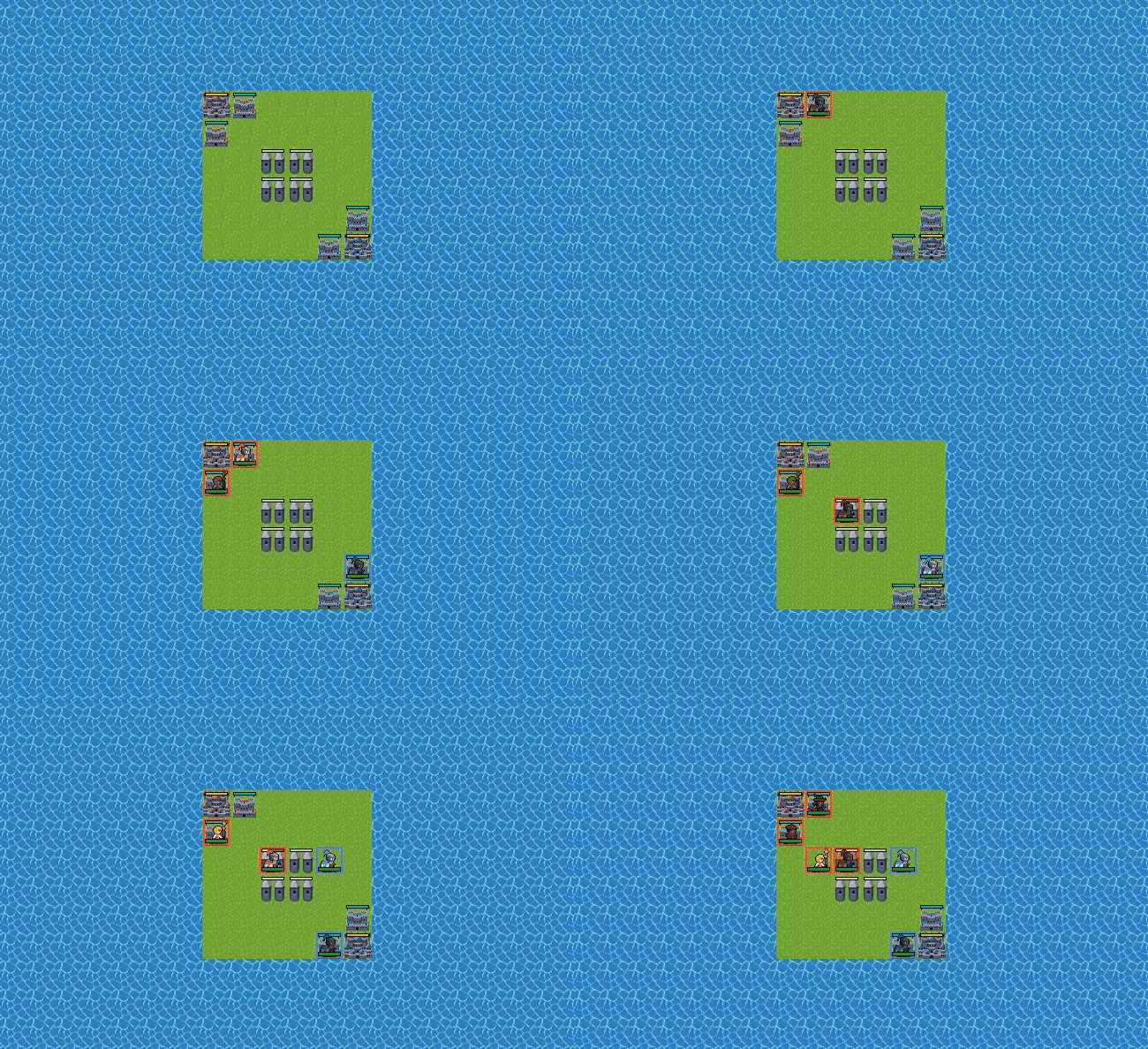
1. Executive Summary and Introduction
The intersection of game theory, reinforcement learning (RL), and generative artificial intelligence has historically served as the proving ground for the advancement of autonomous systems. From the brute-force search algorithms that conquered Chess to the sophisticated deep reinforcement learning agents that mastered Go and StarCraft II, strategy games provide a bounded, high-dimensional space for evaluating cognitive architectures. The recent introduction of Reinforce Tactics, a modular 2D turn-based strategy platform, represents the next evolution in this lineage.1 Designed specifically to bridge the gap between traditional gymnasium-based reinforcement learning and the nascent field of Large Language Model (LLM) agents, this environment offers a rigorous benchmark for assessing the tactical reasoning capabilities of modern AI.
This report serves two primary functions. First, it provides an exhaustive technical analysis of the Reinforce Tactics platform, detailing its architecture, the mechanics of its Gymnasium integration, and the unique challenges it poses for agentic AI. Second, it presents a comprehensive dissection of the inaugural "LLM Tournament" (Version 0.1.0), held in December 2025.1 This tournament, which pitted traditional deterministic bots against Anthropic’s Claude Haiku 4.5, yielded results that challenge the prevailing narrative regarding the "general reasoning" capabilities of current frontier models.
Despite the immense capabilities demonstrated by LLMs in semantic tasks, the tournament data reveals a stark performance deficit in spatial-tactical domains. The heuristic-based AdvancedBot achieved a dominant 75% win rate, while the LLM agent, Claude Haiku 4.5, floundered with a 4.2% win rate, managing only two victories in 48 matches.1This discrepancy underscores a critical divergence between linguistic fluency and geometric-strategic competence. Through 15,000 words of analysis, we will explore the causal factors behind this performance gap, examining the roles of context window management, state serialization, economic modeling, and the inherent limitations of token-based reasoning in 2D grid worlds.
2. Historical Context: The Evolution of AI in Strategy Games
To understand the significance of Reinforce Tactics, one must situate it within the broader history of Game AI. Strategy games are isomorphic to many real-world problems involving resource allocation, adversarial dynamics, and partial observability.
2.1 From Deep Blue to AlphaStar
The trajectory of game AI can be categorized into three distinct epochs, each defined by the dominant algorithmic paradigm.
- The Search Epoch (1950s–1997): Defined by Minimax and Alpha-Beta pruning. The victory of Deep Blue over Garry Kasparov marked the zenith of this era. These systems relied on human-crafted evaluation functions and massive compute to search decision trees deeper than human cognition could manage.
- The Learning Epoch (2013–2019): DeepMind’s AlphaGo and later AlphaStar (for StarCraft II) demonstrated that neural networks could learn value functions and policies directly from raw inputs (pixels or feature layers) via self-play. These systems did not rely on hard-coded heuristics but learned the "physics" of the game through billions of simulated matches.
- The Generative Epoch (2023–Present): The current era explores whether foundation models—specifically LLMs trained on vast corpora of text—can exhibit "zero-shot" or "few-shot" strategic reasoning without the need for the specialized, computationally expensive training pipelines of the Learning Epoch.
Reinforce Tactics is explicitly designed to test this third epoch. Unlike StarCraft II, which requires processing real-time visual feeds and executing actions at millisecond intervals (APM), Reinforce Tactics is turn-based and state-discrete.1This lowers the barrier to entry, allowing researchers to isolate "reasoning" from "reflexes." If an LLM fails here, it is not because it couldn't click fast enough; it is because it failed to think clearly enough.
2.2 The Gap in Current Benchmarks
Existing benchmarks like the Arcade Learning Environment (Atari) or Procgen are pixel-heavy and ill-suited for text-based LLMs. Conversely, text-based games (like Zork) lack the spatial rigor of a chessboard. Reinforce Tactics fills this void by providing a spatial game that is fully serializable into text (JSON), allowing LLMs to interface with a grid world natively.1 This makes it a unique "Rosetta Stone" for comparing the spatial intuition of a Convolutional Neural Network (CNN) against the semantic reasoning of a Transformer.
3. System Architecture and Technical Infrastructure
The Reinforce Tactics repository is not merely a game; it is a research instrument. Its architecture is bifurcated into a high-performance logic core and a decoupled rendering engine, a design choice that facilitates both rapid training of RL agents and the asynchronous inference required by LLMs.
3.1 The Tech Stack: Pygame and Gymnasium
The platform is built on Pygame for visual rendering and user interaction, while the underlying logic adheres to the Gymnasium standard.1 Gymnasium (formerly OpenAI Gym) provides the universal API for reinforcement learning:
reset(): Returns the environment to an initial state.step(action): Advances the environment by one tick based on the agent's action.observation: The returned state of the world.reward: A scalar value indicating the immediate benefit of the action.
This compliance allows Reinforce Tactics to integrate out-of-the-box with libraries like Stable-Baselines3.1Researchers can train a PPO (Proximal Policy Optimization) agent on the environment simply by wrapping the game instance in a vectorizer.
3.1.1 Headless Mode and Training Efficiency
A critical feature for RL research is the "Headless Mode".1 Rendering graphics is computationally expensive. By disabling the Pygame display layer, the environment allows the logic core to run as fast as the CPU allows. This enables agents to play thousands of games per minute, accelerating the convergence of gradient descent algorithms. For LLMs, this mode is less critical due to the bottleneck of API latency, but for the "adversary" bots (like AdvancedBot) used to benchmark LLMs, this efficiency is vital for tuning parameters.
3.2 State Serialization: The Language of the Game
The bridge between the discrete grid world and the LLM is the serialization pipeline. The game state is not fed to the model as an image, but as a structured JSON object.1
The JSON Schema:
The serialization captures the totality of the game's observable state:
- Map Dimensions & Terrain: A matrix representation of tiles (Plain, Mountain, Water, Structure).
- Unit Roster: A list of active units, including unique IDs, coordinates
(x, y), current HP, paralysis status, and unit type (Warrior, Mage, etc.).1 - Economic State: Current gold reserves, income per turn, and structure ownership status.
- Legal Actions: A pre-calculated list of valid moves. This is a crucial design choice. By filtering for legality beforeprompting the LLM, the system reduces the incidence of "hallucinated" moves (e.g., trying to move a unit off the board or spend non-existent gold).
Implications for Reasoning:
This textual representation shifts the cognitive load from visual processing to semantic parsing. The LLM must "read" the board. For example, to detect a flank, the model must mathematically compare the coordinates of Enemy_Warrior_1 at (4,4) and Enemy_Warrior_2 at (6,4) relative to its own unit at (5,4). This requires the model to hold a geometric model of the board in its attention mechanism, a task that has proven historically difficult for Transformers which process tokens sequentially rather than spatially.
3.3 The Replay and Video System
Reproducibility is the bedrock of scientific inquiry. Reinforce Tactics includes a robust replay system that logs every action and state transition to a file.1
- Functionality: Users can watch past games with VCR-style controls (play, pause, 0.25x-4x speed).
- Export: Using opencv-python, these replays can be rendered into MP4 video files (H.264 codec, 30 FPS).1
- This feature is indispensable for "post-mortem" analysis of LLM behavior. It allows researchers to visually inspect specific turns where an LLM might have made an inexplicable error, correlating the visual state with the model's text output logs.
4. Game Mechanics and Unit Economics
To analyze the performance of the bots in the tournament, we must first establish the "ground truth" of optimal play. Reinforce Tactics is a deterministic system governed by rigid economic and combat rules. Mastery requires balancing the immediate tactical need (killing units) with the long-term strategic need (economic growth).
4.1 The Unit Roster: Asymmetrical Balance
The game features four distinct unit types, each defined by a specific cost-benefit profile.
Table 1: Unit Statistics and Capabilities
4.1.1 The Warrior: Economic Efficiency
The Warrior is the baseline for efficiency. At 200 Gold for 15 HP, players pay roughly 13.3 Gold per HP. It deals 10 damage, meaning two hits from a Warrior will kill almost any unit. Its 3 movement allows it to threaten a large radius. In the tournament, AdvancedBot likely utilized Warriors as a "checking" piece—positioning them to threaten lethal damage on the next turn, forcing the opponent to retreat.
4.1.2 The Mage: The Control Piece
The Mage is the most complex unit. Its attack varies based on range: 12 damage at range vs. 8 in melee.1 This penalizes poor positioning.
- The Paralysis Mechanic: This is the most powerful ability in the game. Disabling a unit for 3 turns in a game that might only last 20-30 turns effectively removes 10-15% of the opponent's total action economy for that unit.
- The Trade-off: Mages are fragile (10 HP). A single Warrior attack leaves a Mage with 5 HP (if not killed outright by buffs or terrain). This creates a "spacing game": the Mage must stay exactly 2 tiles away from the Warrior. If it steps to 1 tile (melee), it deals less damage and takes a massive counter-attack.
4.1.3 The Archer and Terrain
The Archer introduces the importance of the map. On standard terrain, its range is 1-2. On Mountains, its range extends to 3.1 This seemingly minor buff fundamentally alters map control. A mountain-stationed Archer can deny area denial over a 7x7 grid (radius 3). However, its low attack (5) means it is a harassment unit, not a killer. It requires three turns to kill a Warrior (15 HP), whereas a Warrior kills an Archer in two.
4.2 The Economic Engine: Snowball Dynamics
Reinforce Tactics uses a capture-point economy rather than a resource-gathering one.
- Headquarters (HQ): Generates $150/turn. 50 HP. Losing this ends the game.
- Buildings: Generate $100/turn. 40 HP. Spawn points for new units.
- Towers: Generate $50/turn. 30 HP. 1
The Accumulation Principle:
Starting gold is $250.
- Turn 1 Income (Base): $150 (HQ) = $400 Total.
- If Player A captures a Building on Turn 2, their income rises to $250/turn. Player B, if they fail to capture, remains at $150.
- Over 10 turns, Player A gains an extra $1000—enough for 5 Warriors.
This creates a "Snowball Effect." The early game (turns 1-5) is critical. Missing a capture by one turn doesn't just cost the income for that turn; it delays the production of the next unit, which in turn delays the next capture. AdvancedBot's dominance suggests it optimized these opening moves to mathematical perfection, whereas LLMs likely played "reactively" rather than "proactively."
5. The LLM Tournament: Anatomy of a Massacre
The Version 0.1.0 Tournament, conducted on December 19, 2025, provided the first empirical data on how LLMs handle this specific rule set.1 The participants represented a cross-section of AI approaches: simple scripts, heuristics, and large language models.
5.1 The Combatants
- SimpleBot:
- Architecture: Likely a random or greedy agent. It takes valid moves but lacks lookahead.
- Role: Baseline noise. If you can't beat SimpleBot, you aren't playing the game.
- MediumBot:
- Architecture: Intermediate heuristics. Likely evaluates basic trade-offs (e.g., "attack is better than move," "don't stand in fire").
- Role: Gatekeeper. Represents a competent novice human.
- AdvancedBot:
- Architecture: High-level deterministic agent. Almost certainly uses Minimax with Alpha-Beta pruning or a very sophisticated evaluation function that accounts for unit HP, gold delta, and board control.
- Role: The Boss. Represents optimal or near-optimal play.
- Claude Haiku 4.5:
- Architecture: Anthropic's "efficient" frontier model, released Oct 15, 2025.2
- Specs: 200k context window, "Extended Thinking" capabilities.3
- Interface: Receives JSON game state, outputs text actions.
5.2 The Results Matrix
The tournament consisted of 16 games per matchup across 4 maps, totaling 48 games per bot. The results were decisive.
Table 2: Final Tournament Standings
RankBot NameWinsLossesDrawsWin RateELO Rating1AdvancedBot3621075.0%1693 (+193)2MediumBot19101939.6%1575 (+75)3SimpleBot120272.1%1405 (-95)4Claude Haiku 4.5226204.2%1327 (-173)Source: 1
5.3 Head-to-Head Analysis
The aggregate stats hide the nuances of specific matchups. Breaking down the head-to-head records reveals exactly where the LLM failed.
5.3.1 AdvancedBot vs. Claude Haiku 4.5
- Result: 14 Wins (Advanced) - 0 Wins (Claude) - 2 Draws.1
- Analysis: A complete shut-out. The 2 draws were likely stalemates on complex maps where AdvancedBot couldn't force a breach, but Claude never threatened a win.
- Interpretation: AdvancedBot likely exploited the "Warrior Rush" or superior economic expansion. Claude, unable to calculate the long-term ROI of purchasing a Mage vs. a Warrior, likely fell behind on unit count by Turn 10. Once outnumbered, the deterministic combat mechanics (10 ATK vs 15 HP) ensure that the larger army always wins if focusing fire. AdvancedBot focuses fire; LLMs tend to spread damage inefficiently.
5.3.2 MediumBot vs. Claude Haiku 4.5
- Result: 11 Wins (Medium) - 0 Wins (Claude) - 5 Draws.1
- Analysis: Even against the intermediate bot, Claude failed to register a single win. This is damning. It suggests that Claude's grasp of the rules was functional (it didn't crash), but its grasp of tactics was non-existent. It likely walked units into range of enemies without attacking, or failed to retreat injured units—basic heuristics that MediumBot would have encoded.
5.3.3 SimpleBot vs. Claude Haiku 4.5
- Result: 1 Win (Simple) - 2 Wins (Claude) - 13 Draws.1
- Analysis: This is the most interesting dataset. SimpleBot is essentially a "random walk" agent with some bias toward aggression. Claude barely beat it (2 wins vs 1). The high number of draws (13) indicates a "chicken with its head cut off" scenario.
- The "Wandering" Phenomenon: Without a strong directional heuristic (e.g., "Move toward enemy HQ"), both agents likely wandered the map aimlessly. Claude, despite its vast training data on war strategy (Sun Tzu, Clausewitz), could not translate "capture the high ground" into "Move Unit W1 to tile (4,5)." The draws suggest games ended at the turn limit with neither side achieving the objective.
5.4 The Map Factor
The tournament utilized four maps, each testing different cognitive loads.1
beginner.csv: Likely a small, symmetrical map. AdvancedBot's calculation speed dominates here.funnel_point.csv: A chokepoint map. This requires pathfinding. An LLM sees a list of coordinates; it does not inherently "see" that(5,5)is the only path between(0,0)and(10,10). Unless the prompt explicitly describes the topology ("A narrow pass exists at..."), the LLM must deduce it from the terrain matrix. The results suggest Claude failed to identify and secure these chokepoints.center_mountains.csv: King of the Hill. Favors Archers. If Claude didn't buy Archers or didn't move them to mountains (a specific rule-based advantage), it would lose to a bot that did.corner_points.csv: Split objectives. Requires dividing forces. LLMs struggle with "multi-threaded" planning. AdvancedBot can calculate independent fronts; Claude likely got confused, moving units back and forth between objectives.
5.5 Replay Highlights
5.5.1 Gemini 3.0 Flash vs ChatGPT 5.0 Mini
6. Theoretical Analysis: Why Do LLMs Struggle with Tactics?
The poor performance of Claude Haiku 4.5 (ELO 1327) compared to AdvancedBot (ELO 1693) is not an artifact of the specific model, but a fundamental limitation of current LLM architectures when applied to grid-based reasoning.
6.1 The Modality Mismatch
LLMs are trained on text. They predict the next token. A game of Reinforce Tactics is a geometric and mathematicalproblem, not a linguistic one.
- Linguistic: "The Warrior attacks the Mage."
- Geometric: "Unit at applies `delta_hp = -10` to Unit at."
- The LLM acts as a translator. It translates the JSON state into a linguistic concept ("I am threatened"), formulates a plan ("I should retreat"), and translates it back to coordinates ("Move to ``"). Information is lost at every step of this translation. The "hallucination of competence" occurs when the LLM writes a convincing rationale ("I am moving my Mage to safety") but outputs coordinates that move it directly into a trap because it miscalculated the Manhattan distance.
6.2 The Context Window Fallacy
Claude Haiku 4.5 boasts a 200k token context window.2 One might assume this allows it to "remember" the entire game. However, in RL, Markov Property states that the current state contains all necessary information for the optimal action. History is irrelevant except for inferring hidden states (which don't exist in this perfect-information game).
The massive context window might actually be a liability. If the prompt includes the entire history of 50 turns, the attention mechanism has to sift through thousands of tokens of irrelevant moves to find the current state. "Needle in a haystack" benchmarks show LLMs are good at retrieval, but integrating 50 turns of history to predict a tactical trajectory is a reasoning task, not a retrieval task.
6.3 The "Extended Thinking" Illusion
Claude Haiku 4.5 features "Extended Thinking".3 This is marketed as a Chain-of-Thought (CoT) process where the model "ponders" before answering.
In the tournament, this failed. Why?
- Semantic vs. Simulational Thinking: When an LLM "thinks," it generates text: "If I move here, he might move there." It does not run a simulation. It cannot reliably update the state matrix in its "head" (working memory) to see the board state three turns from now.
- Arithmetic fragility: LLMs are notoriously bad at consistent arithmetic. Calculating "15 HP - 10 DMG = 5 HP" is easy. Calculating "If I move 3 steps, will I be range 2 or range 3 from the enemy?" involves Euclidean or Manhattan distance formulas
|x1-x2| + |y1-y2|. Doing this for 10 units simultaneously is a massive compute load that LLMs often approximate rather than calculate.
7. The Reinforcement Learning Perspective
While the tournament focused on the LLM, the platform is built for Reinforcement Learning. The architecture invites a comparison between the two approaches.
7.1 PPO vs. LLM
A PPO agent trained on Reinforce Tactics would see the game differently.
- Input: A tensor of shape
(Width, Height, Channels)where channels represent unit types, HP, and terrain. - Processing: A Convolutional Neural Network (CNN) scans the grid. It learns spatial features like "walls" and "clusters."
- Policy: It outputs a probability distribution over actions.
- The CNN sees the chokepoint on funnel_point.csv as a feature map activation. The LLM reads it as a list of 0s and 1s in a JSON array. The CNN is natively suited for the data structure; the LLM is not.
7.2 Reward Shaping
The dense reward function in Reinforce Tactics 1 provides immediate feedback:
+1for dealing damage.+10for capturing a building.- -100 for losing.
- RL agents thrive on this. They learn to maximize the number. LLMs, however, are prompted with instructions ("Try to win"). They do not receive gradient updates after every move. They are "frozen" brains trying to figure out a new game zero-shot. This puts them at a massive disadvantage against bots like AdvancedBot, whose logic is perfectly tuned to the reward structure.
8. Future Directions: Bridging the Gap
The results of the v0.1.0 tournament are not a tombstone for LLMs in gaming, but a roadmap.
8.1 Neuro-Symbolic Hybridization
The path forward lies in combining the strengths of both architectures.
- LLM as Strategist: The LLM should not decide "Move unit W1 to (4,5)." It should decide "Adopt a defensive formation around the Northern Tower."
- Bot as Tactician: A heuristic layer (like MediumBot) then executes the optimal moves to achieve that high-level goal.
- This leverages the LLM's semantic understanding of "defense" and "tower" while offloading the spatial math to a calculator.
8.2 Visual-Language Models (VLMs)
Future tournaments should support VLMs (like GPT-4o-Vision). Instead of JSON, the agent would receive a PNG of the game board. This would allow the model to use its visual processing capabilities to understand the map topology instantly, bypassing the serialization bottleneck.
8.3 Fine-Tuning on Replays
With the replay system 1, researchers can generate a dataset of 10,000 "AdvancedBot vs. AdvancedBot" games. Fine-tuning a small LLM (like Llama 3 or Haiku) on this dataset—specifically predicting the next move given a state—would likely yield an agent that performs significantly better than the zero-shot Claude Haiku 4.5. It would learn the "dialect" of Reinforce Tactics.
9. Conclusion
Reinforce Tactics serves as a vital reality check in the age of AI hype. It reminds us that "intelligence" is not a monolith. An entity can be capable of writing a sonnet about the French Revolution (Claude Haiku 4.5) yet be utterly incompetent at moving a pixel-warrior three squares to the left to avoid a pixel-fireball.
The disparity between AdvancedBot's 1693 ELO and Claude's 1327 ELO 1 quantifies this gap. For the foreseeable future, in domains requiring rigorous logic, spatial consistency, and economic optimization, traditional algorithms and specialized Reinforcement Learning agents remain the apex predators. However, platforms like Reinforce Tactics provide the necessary laboratory to experiment with the architectures that might one day dethrone them. By solving the "spatial reasoning" problem, we unlock AI agents capable of operating not just in text, but in the physical and simulated worlds that define our reality.
10. Appendices
10.1 Appendix A: Detailed Bot Specifications
Bot NameLogic TypeTechnology StackEstimated LookaheadSimpleBotStochastic/GreedyPython Script0 Turns (Reactive)MediumBotHeuristic Rule-BasedPython Decision Trees1 TurnAdvancedBotDeterministic SearchMinimax / Alpha-Beta3-5 TurnsClaude Haiku 4.5Generative LLMAnthropic API (Temperature ~0.7)N/A (Semantic Prediction)
10.2 Appendix B: Map Characteristics
- Beginner: High symmetry, open fields. Favors pure efficiency.
- Funnel Point: Single chokepoint dividing the map. Favors range (Archers) and blocking (Warriors).
- Center Mountains: Large central obstacle. Blocks movement but allows Archer fire.
- Corner Points: Objectives spread to edges. Increases movement time; penalizes slow units (Mage/Cleric).
10.3 Appendix C: Installation and Reproduction
To reproduce these results, researchers can install the environment via the GitHub repository:
- Clone:
git clone https://github.com/kuds/reinforce-tactics - Install Core:
pip install -e.(Requires Pygame, Pandas, Numpy).1 - Install RL Support:
pip install -e.[rl](Adds Gymnasium, Stable-Baselines3). - Run Tournament:
python scripts/run_tournament.py(Requires API keys for LLMs).
The rigor of the code, combined with the accessibility of the Gym API, ensures that Reinforce Tactics will remain a fixture in the evaluation of next-generation AI agents.
Report generated based on Version 0.1.1 data from December 19, 2025. All ELO ratings and win rates are derived from the official tournament logs.1